How a chalazion forms
Each eyelid has around 30 meibomian glands that secrete oil into the tear film. If a gland's opening blocks, oil backs up, the gland swells, and the trapped oil leaks into the surrounding lid tissue, where the body walls it off with a granuloma. The result is a firm nodule, a few millimeters to a centimeter across, within the lid rather than at its edge. It may start as a tender red swelling like a stye and become painless as the acute phase settles, or it may appear quietly.
Symptoms
A lump in the upper or lower lid, felt more than seen at first, then visible as a swelling; mild heaviness; and, with a large chalazion on the upper lid, pressure on the cornea that blurs vision by inducing astigmatism. Pain is mild or absent unless it becomes secondarily infected.
Treatment
- Warm compresses for ten minutes two to four times daily, followed by gentle massage toward the lid margin, for several weeks; this resolves most chalazia
- Lid hygiene to reduce the blepharitis that usually underlies it
- A steroid injection into the chalazion, which shrinks many within a couple of weeks and is done in the office in a minute
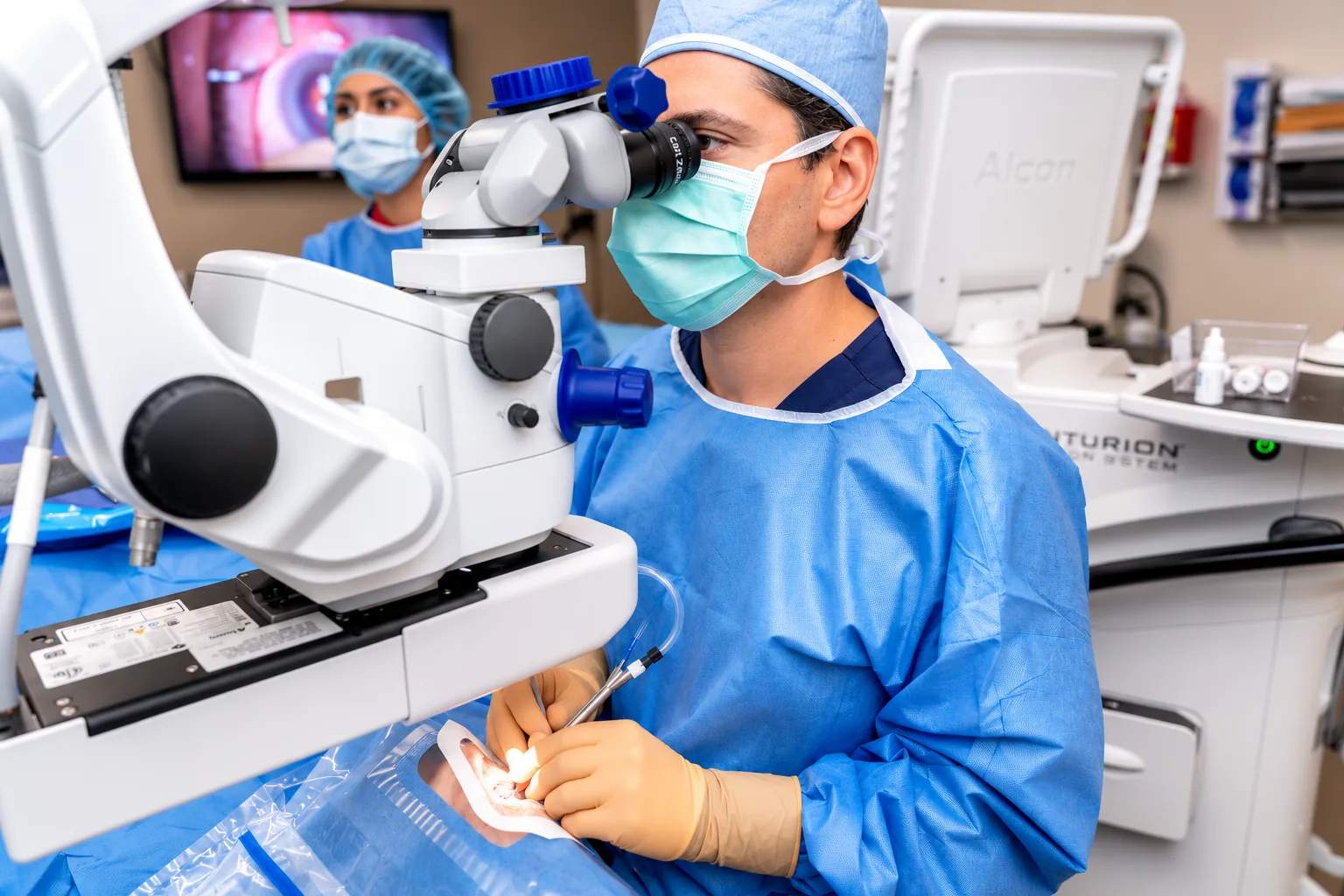
- Incision and drainage: under local anesthetic, the lid is everted, a small incision is made on the inner surface, and the contents are cleared; it takes a few minutes, needs no stitches and leaves no external scar
- Any chalazion that recurs in the same place, or looks unusual, is sent for examination under the microscope, because a rare eyelid tumor can mimic one
Preventing recurrence
Treat the meibomian gland dysfunction, blepharitis or rosacea behind it: regular warm compresses and lid cleansing, and, where indicated, a course of doxycycline or gland treatments such as thermal pulsation, where offered. Evidence on omega-3 supplements is mixed. Patients prone to chalazia find that a short daily routine prevents most of them.
Is this right for your eyes?
Nothing on this page is a diagnosis. Whether this is what is affecting your vision is decided by a full examination at one of our 4 offices: Pasadena, Huntington Beach, Woodland Hills and Beverly Hills.
About this content: This page was written with the assistance of AI tools and reviewed for medical accuracy by Dr. Bavand Youssefzadeh, DO. It is general information, not medical advice, and does not replace an eye examination. Individual results vary. Read our medical disclaimer.