Regular and irregular astigmatism
Regular astigmatism is symmetric: the cornea is steeper along one meridian than the one at right angles, like the back of a spoon, and a cylindrical lens at the right axis corrects it fully. It is the common kind, and everything on this page corrects it. Irregular astigmatism, from keratoconus, scarring or previous surgery, varies from point to point and cannot be corrected by glasses or standard procedures; it is managed with specialty contact lenses and by the cornea specialist.
Laser correction
LASIK, PRK and SMILE reshape the cornea to remove the difference between its meridians. LASIK and PRK can correct regular astigmatism up to roughly six diopters and SMILE up to about three, depending on corneal thickness and the surgeon's assessment, along with any nearsightedness or, with LASIK and PRK, farsightedness. Custom treatment profiles, where appropriate, can treat it precisely. The choice among the three follows the cornea's thickness, the tear film and lifestyle, as for any laser candidate.
The toric EVO ICL
For astigmatism with high nearsightedness, thin corneas or dry eyes in patients aged 21 to 45, the toric version of the EVO ICL carries the astigmatism correction, within its approved range of about 1 to 4 diopters, in a lens placed inside the eye, oriented to the correct axis at surgery. It corrects nearsightedness and astigmatism together and removes no corneal tissue.
Toric lens implants
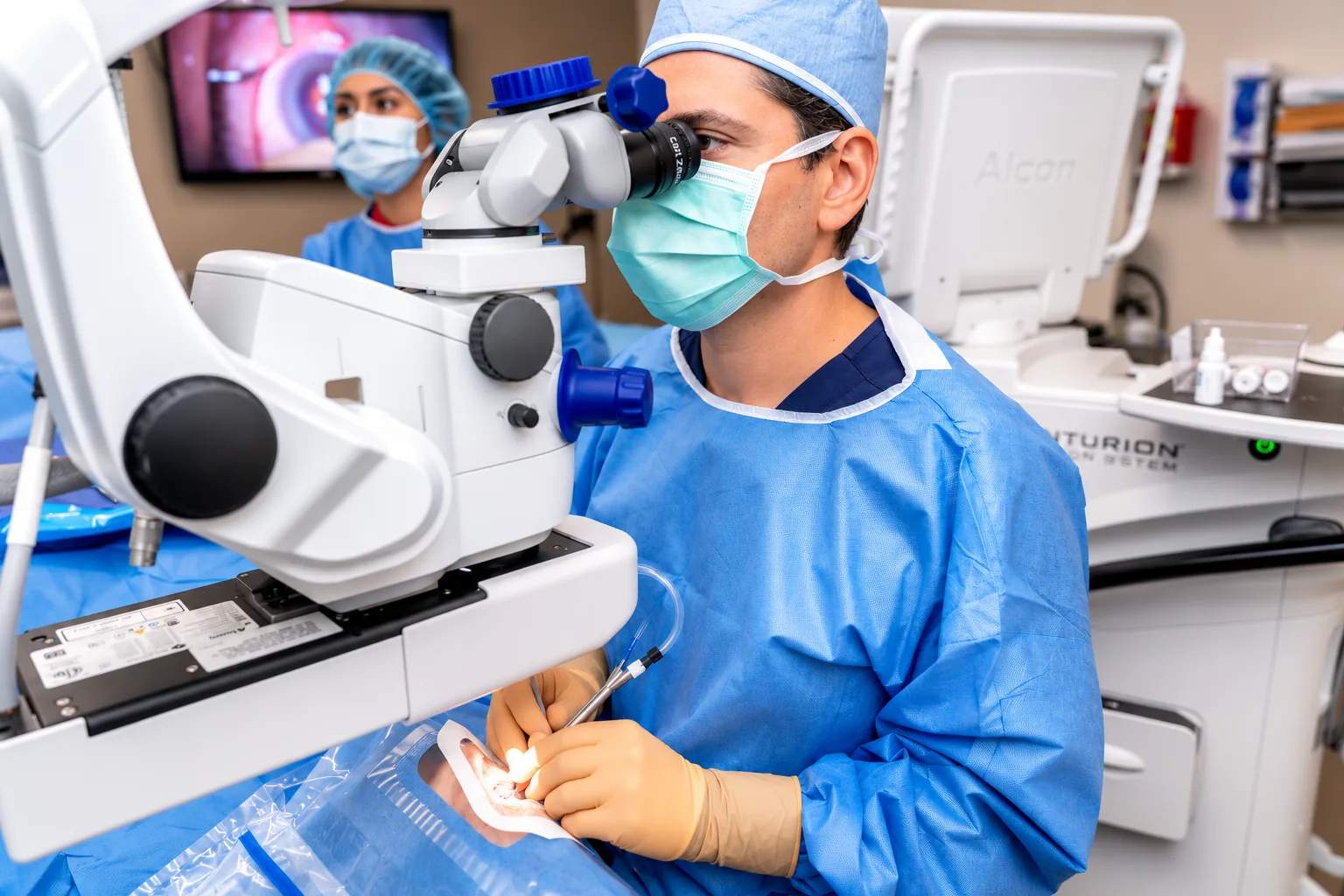
At cataract surgery or Refractive Lens Exchange, a toric implant corrects astigmatism in the same operation, carefully aligned, and where appropriate image guidance or aberrometry may be used. It is available in monofocal, extended depth of focus and multifocal designs, so astigmatism correction can be combined with reading vision. Smaller amounts may, where appropriate, be treated with arcuate incisions at the same surgery.
Contact lenses and glasses
Toric soft lenses correct moderate astigmatism; custom torics, rigid, hybrid and scleral lenses correct high and irregular astigmatism. Glasses correct any amount of regular astigmatism. These remain the right answer for patients who prefer them, for children, and for eyes not suited to surgery.
Which is right
Age, the amount and regularity of the astigmatism, the cornea's thickness and shape, the state of the natural lens and your goals decide. The consultation measures the astigmatism with corneal topography and, where appropriate, tomography of the back surface of the cornea, and recommends accordingly.
Is this right for your eyes?
Nothing on this page is a diagnosis. Whether this is the right choice for you is decided by a full examination at one of our 4 offices: Pasadena, Huntington Beach, Woodland Hills and Beverly Hills.
About this content: This page was written with the assistance of AI tools and reviewed for medical accuracy by Dr. Bavand Youssefzadeh, DO. It is general information, not medical advice, and does not replace an eye examination. Individual results vary. Read our medical disclaimer.