
Refractive Lens Exchange: Lens Replacement Surgery
 Model
Why Vision Correction Matters
Refractive Lens Exchange borrows the technique of cataract surgery and applies it before a cataract ever forms. The aging natural lens is replaced with an implant chosen for the distances you care about, and because that lens can never cloud, a cataract is taken off the table for good. At Global LASIK and Cataract, Dr. Bavand Youssefzadeh and our clinical team use the same premium implant options and the same careful measurements as our cataract service.
Somewhere in your forties the natural lens stops flexing, and reading glasses appear on every surface in the house. It is not a disease, but it is a daily tax on how you work, cook and read.
Laser vision correction reshapes the cornea, which cannot restore that lost flexibility. Replacing the lens itself addresses the actual cause, which is why RLE is often the better answer, usually over the age of about 45.
 Model
What Is RLE?
Refractive Lens Exchange is a quick outpatient procedure that replaces your eye’s aging lens with an advanced artificial lens implant. The new lens is chosen and customized for your eyes and lifestyle and, depending on the lens you choose, often provides clear vision at near, intermediate and distance without glasses.
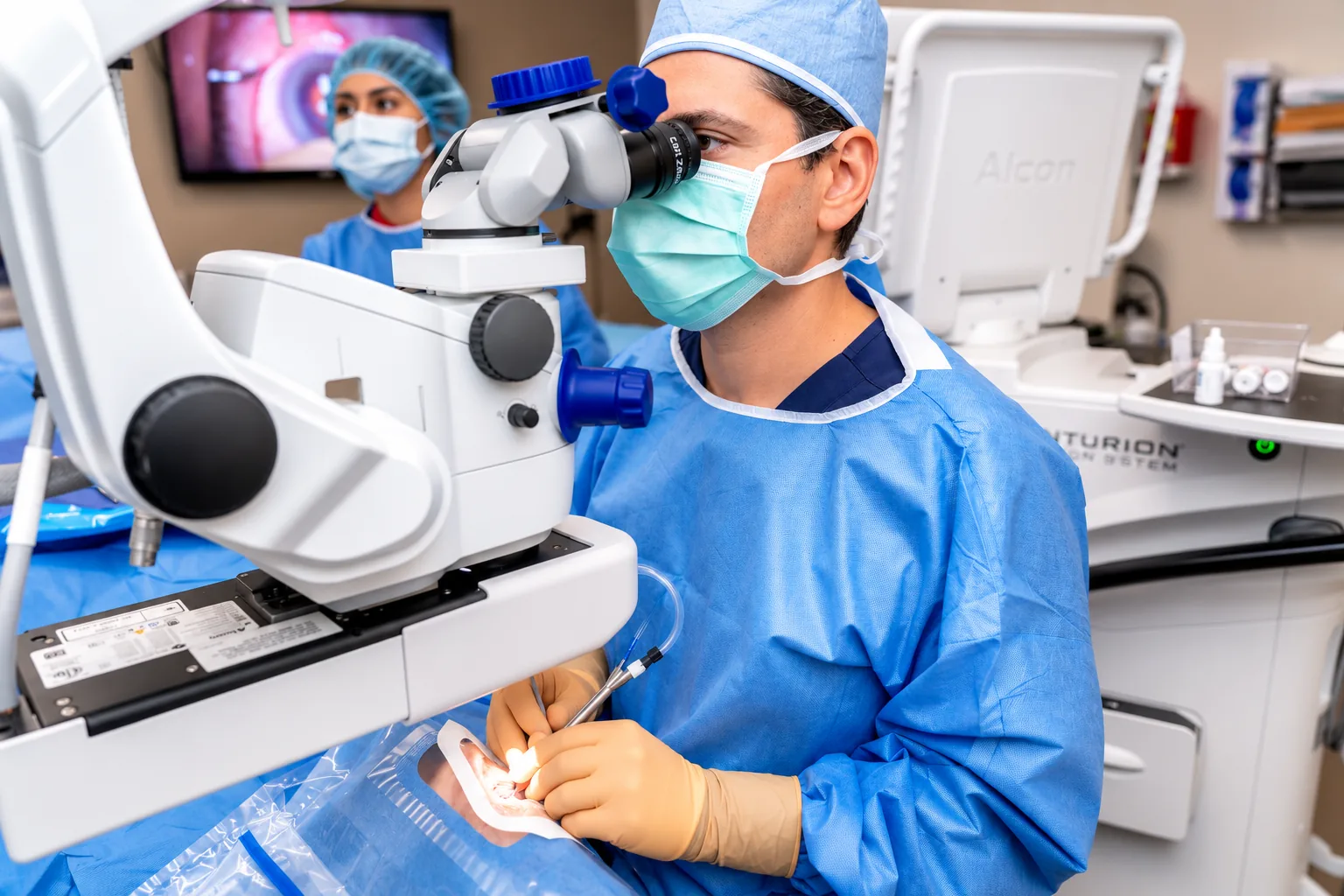
The procedure takes roughly 15–20 minutes per eye under light sedation, uses a self-sealing incision, and requires no stitches and no overnight stay.
How RLE Works
- 1
Comprehensive Evaluation
We map the eye and talk through how you read, drive and use screens so the implant matches your real day.
- 2
Gentle Lens Exchange
The natural lens is removed through a micro-incision and the chosen implant is placed into the same capsule.
- 3
Quick Recovery
You go home the same day, and most patients return to normal activities within 24–48 hours.
- 4
Life With Clear Vision
Depending on the lens you choose, near, intermediate and distance vision with less reaching for readers, and no cataract in your future.
Why Patients Choose RLE
- Can address presbyopia with the right implant
- Rules out any future cataract in the treated eye
- Suitable for prescriptions too strong for LASIK
- Premium lenses cover near, intermediate and distance
- Outpatient procedure with no stitches and no overnight stay
- Results do not drift as the eye continues to age

 Model
Candidacy and what to expect
You may be an excellent RLE candidate if you:
- Are usually over about 45 and increasingly dependent on reading glasses
- Have a prescription outside the treatable range for LASIK
- Have healthy eyes with no significant retinal disease
- Would rather solve distance and near vision in one procedure
RLE is the right answer for some patients and the wrong one for others. If your natural lens still flexes well, we will tell you so and discuss LASIK or EVO ICL instead. Like any eye surgery, RLE carries risks, which your surgeon reviews with you.
The eye is numbed with drops and you are lightly sedated but awake. The exchange itself takes about fifteen minutes; you are typically in the building for three to four hours.
A friend or family member drives you home. Follow-up visits are typically the next day, one week, one month and three months.
Drops are used for a few weeks. Expect some glare and halo around lights while the brain adapts to a multifocal implant; this settles for the large majority of patients.
Most patients read a menu, a phone and a road sign without glasses within a few weeks, though fine print in poor light may still want a low-power reader.
The second eye is typically treated one to three weeks after the first, once the first result is known.
The implant is permanent and maintenance-free. Annual eye-health checks continue as normal.
We select from monofocal, toric, multifocal and extended-depth-of-focus implants, and in carefully selected cases, after physician evaluation, the light-adjustable implant, rather than defaulting to one lens.
The same surgeon and the same careful measurements used for our cataract service apply here.
Care is available in English, Spanish, Armenian, Farsi and Vietnamese, at four offices across Los Angeles and Orange County.
What patients say about us
Further reading



Affordable Financing Options
RLE is an elective procedure, so we make the cost predictable: flexible monthly payment plans designed to fit nearly any budget, with a written quote before you commit that explains what is included.
0% interest financing up to 18 months on LASIK and up to 24 months on cataract surgery and lens replacement, subject to credit approval.
Take the Next Step
If reading glasses have quietly taken over your day, RLE addresses the cause rather than the symptom.
Meet with our team to learn whether lens exchange is the right procedure for your eyes and your age.
 Model
Frequently Asked Questions
LASIK reshapes the cornea and suits patients under about 45 with a stable prescription. Refractive Lens Exchange replaces the eye's natural lens with a permanent implant, which also addresses the age related loss of reading vision and means you will never develop a cataract. After about 45, RLE is often the better fit.
RLE usually suits patients over about 45 who want to reduce their dependence on both reading and distance glasses, patients with prescriptions too high for laser correction, and patients with early lens changes. A dilated exam and lens measurements confirm candidacy.
It depends on the lens chosen. Multifocal and extended depth of focus options are designed to give useful vision at near, intermediate and far, and most patients with them read without glasses for everyday tasks. In carefully selected cases, after physician evaluation, the Light Adjustable Lens can be fine-tuned for distance, with reading vision addressed by blending the two eyes. A monofocal lens gives clear distance vision with readers for close work.
The procedure is the same: the natural lens is removed and an implant placed. The difference is timing and purpose. Cataract surgery treats a lens that has gone cloudy, while RLE replaces a clear lens to correct vision. Because the lens is gone, you cannot develop a cataract later.
We offer a broad range of the latest lens implant technologies and do not believe that one lens is best for every patient. We work closely with the major manufacturers and offer options including Alcon PanOptix and Vivity; Johnson & Johnson TECNIS Odyssey, PureSee and Eyhance; Bausch + Lomb enVista/Envy; and the RxSight Light Adjustable Lens, among others.
We customize the lens and treatment plan for each individual based on their visual goals, lifestyle, ocular health and clinical findings, rather than promoting one lens platform for everyone.
Cataract and refractive lens exchange (RLE) procedures are performed at the outpatient surgery centers we use. ORA, which measures the eye during surgery, is available for these procedures when appropriate.
Most patients see well within a day or two and return to normal activities within a few days. Eyes are typically treated one to three weeks apart. Drops continue for a few weeks, and vision settles fully over the following months as your brain adapts to the new lens.
RLE is elective, so medical insurance does not cover it. We provide a written quote at your consultation, and financing at 0% interest for up to 24 months is available, depending on the treatment cost and credit approval. FSA and HSA funds can be used.
RLE FAQs
Get quick answers to the most common questions about refractive lens exchange, lens choices, recovery, night vision, and how it compares to LASIK.
This page is general information, not medical advice. Whether a procedure is right for you is decided at an eye examination, and individual results vary. Read our medical disclaimer.