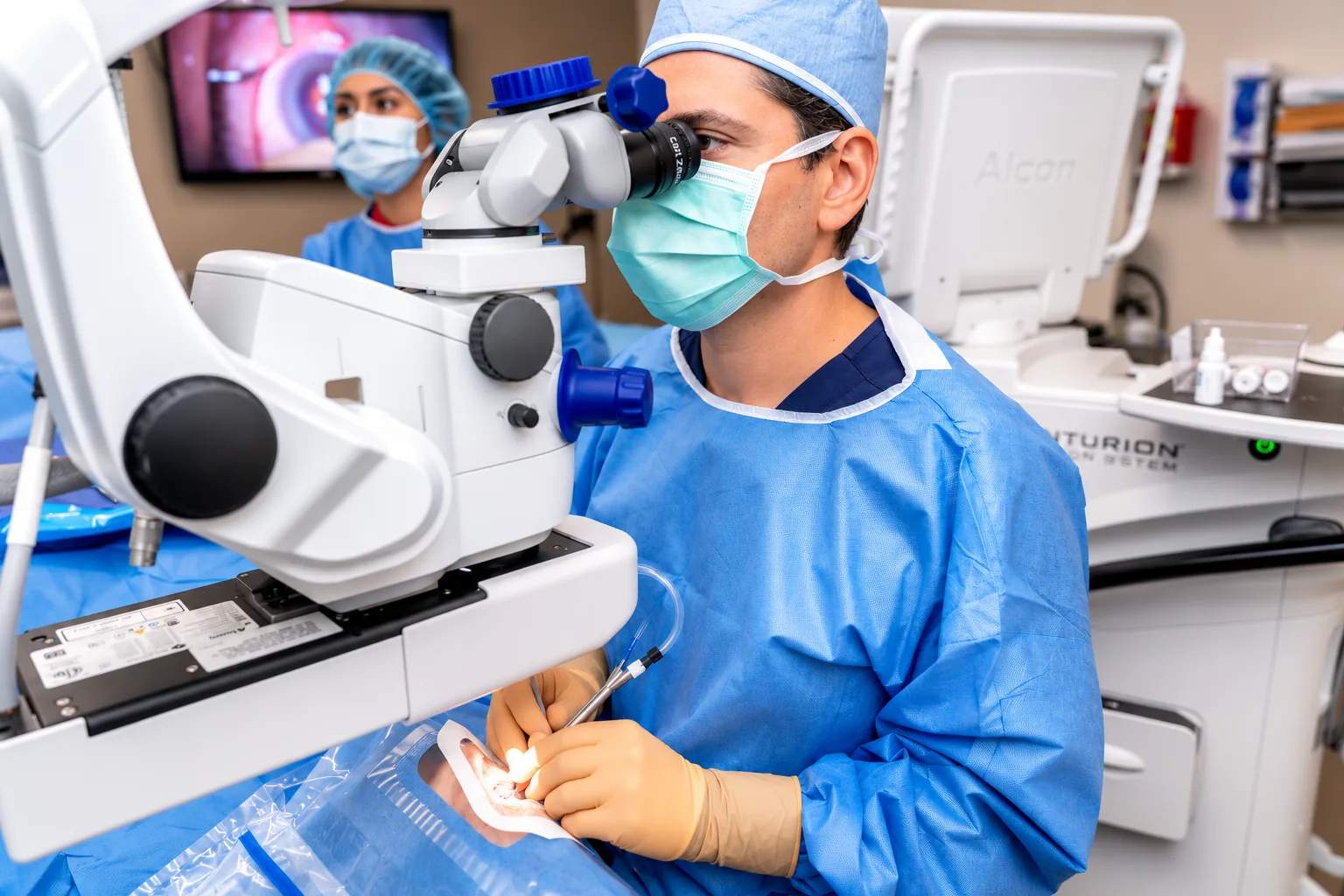
Why the measurement is everything
A lens implant has a fixed power chosen before surgery, and the eye's final prescription depends on how well that power matches the eye. An error of a tenth of a millimeter in axial length shifts the result by about a quarter of a diopter; an error in corneal curvature shifts it similarly. For a monofocal lens a small error means slightly stronger glasses; for a multifocal or toric lens it can undermine the reason the lens was chosen. Biometry is where that error is minimized.
How it works
The instrument sends a beam of low-coherence light into the eye and measures the reflections from the cornea, the lens and the retina, using interference to resolve their positions precisely. In the same session it measures the cornea's curvature over several points, the depth of the anterior chamber and the thickness of the lens, and some instruments also photograph the eye for image guidance. Swept-source versions penetrate denser cataracts. Nothing touches the eye, and the readings are repeated automatically to confirm consistency.
From measurements to lens power
The measurements enter a lens calculation formula, of which there are several, each with strengths in different eye shapes, and the surgeon compares them. Modern formulas incorporate corneal thickness, lens thickness and, for eyes that have had refractive surgery, specialized adjustments. The target refraction (usually distance vision, sometimes deliberate near vision or a blended result) sets the power chosen. For toric lenses the corneal astigmatism measurements set the cylinder and axis.
When biometry is less reliable, and what is done
Eyes that have had LASIK, PRK or RK, very long or very short eyes, corneas with irregular astigmatism, and eyes with unstable tear films all challenge the formulas. For these, options such as intraoperative aberrometry, which checks the power during surgery, and the Light Adjustable Lens, which can be adjusted after surgery, may be discussed. A dry surface is treated and the measurements repeated before they are finalized.
Preparation
Contact lenses out beforehand, soft lenses for several days and rigid lenses for several weeks, because they alter the corneal curvature the calculation depends on. Lubricating drops are used if the surface is dry. The scan itself takes a minute and needs no dilation.
Is this right for your eyes?
Nothing on this page is a diagnosis. Whether this is the right choice for you is decided by a full examination at one of our 4 offices: Pasadena, Huntington Beach, Woodland Hills and Beverly Hills.
About this content: This page was written with the assistance of AI tools and reviewed for medical accuracy by Dr. Bavand Youssefzadeh, DO. It is general information, not medical advice, and does not replace an eye examination. Individual results vary. Read our medical disclaimer.