Is LASIK Right for You? A Pasadena Candidacy Guide
LASIK candidacy in Pasadena depends on your cornea, prescription, and tear film. Schedule a free consultation to see whether LASIK fits your eyes.
By Global LASIK & Cataract InstituteReviewed by Dr. Bavand Youssefzadeh, DO4 min read
 Model
In short
LASIK candidacy in Pasadena comes down to measurements of your cornea, and most adults with a stable prescription, healthy eyes, and corneas thick and regular enough for the procedure qualify. At Global LASIK & Cataract Institute in Pasadena, a free consultation of about 90 minutes maps your corneas and gives you a clear answer for your eyes.
If you live in the San Gabriel Valley and are weighing LASIK, the first question is whether your eyes qualify. This guide covers what makes someone a candidate, which prescriptions LASIK can treat, who should consider a different procedure, and what happens when you come in for a consultation. The Pasadena office of Global LASIK & Cataract Institute on East Colorado Blvd offers LASIK in Pasadena along with a full range of vision care.
What Makes Someone a LASIK Candidate?
Five factors matter most, and a consultation checks all of them. Research on who does well after laser vision correction points to the same measurements, including corneal shape, corneal thickness, prescription size, and age.
- Age and stability. LASIK is approved for adults 18 and over, with most patients treated between their early twenties and mid forties. More important than age is stability. Your prescription should have changed by no more than about half a diopter in the past year.
- Prescription size. LASIK treats a wide range, but very high prescriptions need more tissue removed.
- Corneal thickness and shape. The cornea must be thick enough that a safe amount of tissue remains after the flap and treatment, and regular in shape.
- Tear film health. LASIK temporarily reduces corneal sensation and tear production for a few months, so dry eye is treated first when needed.
- General health. Active eye disease, uncontrolled diabetes, and medications that affect the corneal surface can change the plan.
For a deeper look, see the page on LASIK candidacy.
Which Prescriptions Can LASIK Treat?
Depending on the laser platform and your corneal thickness, LASIK corrects nearsightedness up to roughly -10 to -12 diopters, farsightedness up to about +4 to +6, and astigmatism up to about 6 diopters. Regular astigmatism in that range is routinely corrected.
Higher prescriptions require more tissue removal, so a high prescription combined with a thin cornea points toward the EVO ICL, which corrects up to about -20 without removing tissue. Irregular astigmatism suggests an irregular cornea and needs further evaluation.
Who Should Consider a Different Procedure?
A few situations call for something other than LASIK, or for waiting.
- Thin or mildly irregular corneas. These often do well with PRK. Read about PRK for thin corneas.
- Keratoconus or early signs of it. LASIK on such a cornea can cause it to bulge progressively. A family history raises the bar, though it does not rule you out by itself. The keratoconus page explains the condition.
- Significant dry eye. SMILE, PRK, or the EVO ICL may fit better, or treatment may come first.
- Pregnancy or breastfeeding. Hormones shift the prescription, so treatment waits until at least three months afterward.
- Contact sports or high eye-trauma jobs. A flapless procedure may be preferred.
- Cataract or reading-vision needs after about 45. A lens-based procedure often serves better.
A no for LASIK still leaves several routes to vision correction, including PRK, SMILE, the EVO ICL, and lens-based procedures.
What Happens at a LASIK Consultation in Pasadena?
 Model
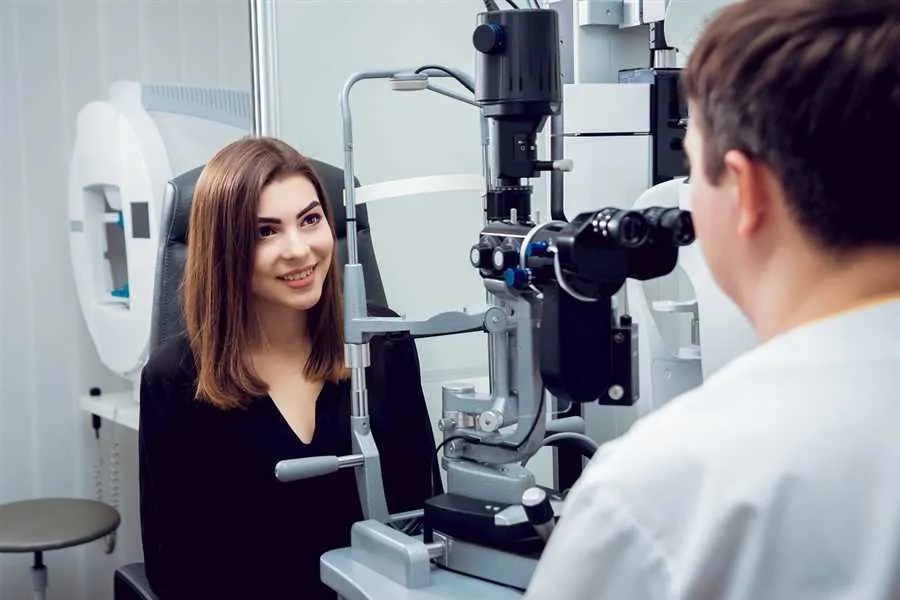
The consultation is a diagnostic visit, not a sales appointment. It takes about 90 minutes and is complimentary, with no obligation to book surgery. Here is how to prepare and what to expect.
Before you arrive. Contact lenses mold the cornea, and the measurements need it in its natural shape. Leave soft lenses out for at least 3 days beforehand, toric soft lenses for 7 days, and rigid gas permeable or scleral lenses for at least 3 weeks. Wear glasses instead, and bring your current glasses, your contact lens prescription, and a list of medications. Bring any records from previous eye surgery or other eye doctors too.
The measurements. Most of the visit gathers the numbers that decide candidacy.
- Your true prescription, measured with and without drops that relax the eye's focusing
- Corneal topography and tomography, maps of the front and back of the cornea that reveal astigmatism, irregularity, and early keratoconus
- Corneal thickness, which sets how much tissue can safely be removed
- Wavefront analysis, the eye's optical fingerprint, used to design a custom treatment
- Pupil size in dim light, which affects night vision after treatment
- A tear film assessment, because dry eye affects healing
You leave with a clear answer on whether LASIK is suitable, which alternative fits if it is not, and a written quote. The LASIK consultation page lists every step. Bring a driver if your eyes are dilated.
Who Will Evaluate Your Eyes in Pasadena?
If you are looking for LASIK surgery in Pasadena, Global LASIK & Cataract Institute serves patients throughout Pasadena, Altadena, South Pasadena, Alhambra, Monterey Park, Rosemead, Arcadia, Sierra Madre, and nearby communities. Your evaluation is led by a fellowship-trained cornea and refractive surgeon. You can learn more about Dr. Bavand Youssefzadeh and the rest of the team, or see the practice's other offices on the locations page. The Pasadena office page has the details specific to this location.
What Is the Best Next Step?
Book the consultation, since only measurements confirm candidacy. If you are ready to find out whether LASIK fits your eyes, request a free consultation with Global LASIK & Cataract Institute in Pasadena, in person or virtually. Results vary from patient to patient.
This article is general information, not medical advice, and does not replace an eye examination. Individual results vary. Read our medical disclaimer.
 Model
Frequently Asked Questions
About 90 minutes. The visit is complimentary and includes corneal mapping, thickness measurements, wavefront analysis, and a tear film assessment, because most of the visit gathers the numbers that decide candidacy. Global LASIK & Cataract Institute ends it with a clear answer, an alternative if LASIK does not fit, and a written quote, with no obligation to book surgery.
Yes, because contact lenses mold the cornea and the measurements need it in its natural shape. Soft lenses come out at least 3 days before, toric soft lenses 7 days, and rigid gas permeable or scleral lenses at least 3 weeks. Wear glasses instead, and bring your current glasses and your contact lens prescription. The team at Global LASIK & Cataract Institute explains the schedule when you book.
Often yes. Regular astigmatism up to about 6 diopters is routinely corrected. Irregular astigmatism suggests an irregular cornea, which needs further evaluation and may point to PRK or specialty lenses. Global LASIK & Cataract Institute checks the shape of your cornea with topography and tomography to tell the two apart.
Not by itself, but it raises the bar. The corneal imaging at Global LASIK & Cataract Institute looks specifically for early signs of keratoconus, which LASIK would worsen. If there is any doubt, a surface procedure or no laser at all is the safer recommendation, and your measurements decide.
That does not mean no vision correction. PRK, SMILE, the EVO ICL, and Refractive Lens Exchange are all options, depending on your eyes. Global LASIK & Cataract Institute designs the consultation to find the right procedure instead of fitting you to LASIK, so you leave with a plan for your eyes.
Talk to our team about your eyes
Every treatment plan starts with a full diagnostic exam and an honest conversation about your options. Candidacy and results vary from patient to patient; a consultation is how we find out what fits you.